Yesterday you chose a spot and set your target tempo. You're on the right path! Today you’ll do the most important step in the whole process: diagnose the issue.
If you’re still making mistakes after practicing, it usually means there’s one detail you’re not noticing yet. Today is about finding that “missing thought.”
What you’ll accomplish today
By the end of Day 2, you’ll have:
A one-sentence diagnosis: “It breaks because...”
The one thing to think about first
A short, video slow-mo check that makes the cause obvious
Step 1: Play it a few times and identify the exact moment
Don’t just say “this bar is hard.” Get specific:
“The shift landing is messy.”
“My finger lifts too early.”
“The string crossing is late.”
“The barre creates tension.”
Circle the exact micro-moment where it goes wrong. The more specific, the better!
Step 2: Film your hands and watch in slow motion
Record just a few seconds of the spot only. Then watch it back once or twice in slow motion and try to analyze what is going wrong. Can you verify whether your analysis in Step 1 was correct?
Here are some things to look for:
late/no preparation
extraneous movements
a sudden tension spike
rushing the transition
Step 3: Use the checklist: “Why did it fail?”
Pick the first one that feels true.
A) Preparation
Was one hand late? Quick test: prepare right hand → prepare left hand (no pressure) → press → play.
B) Shift / arrival
Did the hand arrive, but the fingers weren’t organized? Often the fix is simple: separate the arm shift from finger placement, one at a time.
C) Tension
Did it “work,” but with a panic grip? Quick test: find the minimum pressure needed to get a clean note.
D) Timing
Are you rushing the transition (especially on shifts)? Give yourself extra time for the move – two beats, even three – until it feels calm.
E) Fingering choice
Does it work slow but fail when you get near tempo? Flag it. We’ll test fingerings and mechanics on Day 4.
Step 4: Write your diagnosis sentence
Keep it simple and specific:
It breaks because: ____________________ (e.g., "I'm not looking ahead on my shift")
That’s it! You're not solving it yet – just naming the real issue.
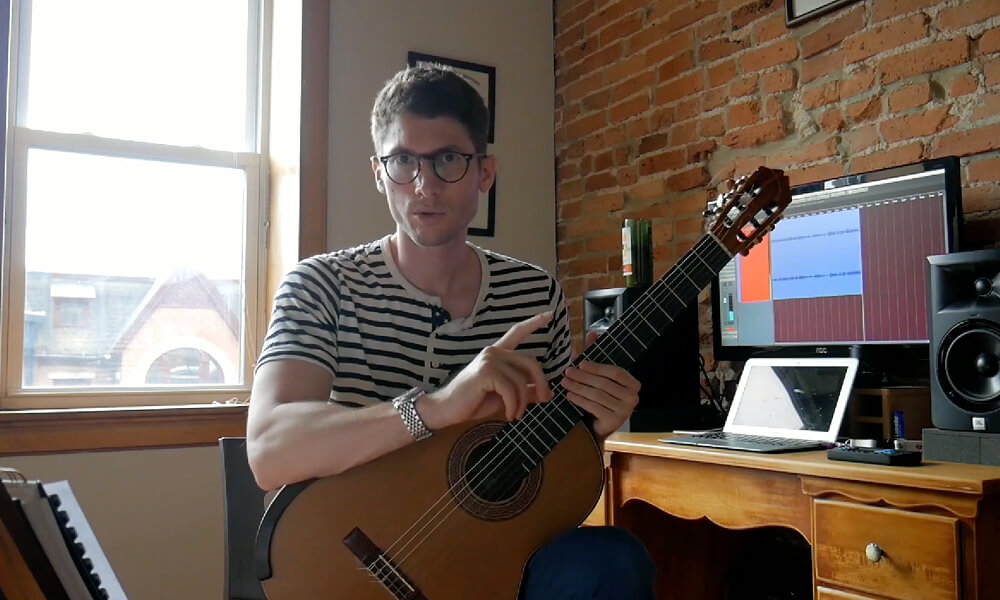
Watch today’s clip (2 minutes)
Thomas Viloteau: “Mistakes = a missing thought”
Before you go
Make sure this is written somewhere you’ll see it tomorrow:
It breaks because: ____________________
Tomorrow you’ll build a “safe version” that you can play cleanly right away, so you stop practicing mistakes and start building reliability. See you then!
Learn From The World's Best Classical Guitarists
Online lessons, courses, and interviews with the greatest minds in classical guitar.